
Doors Without Walls
By Michael P. Evans
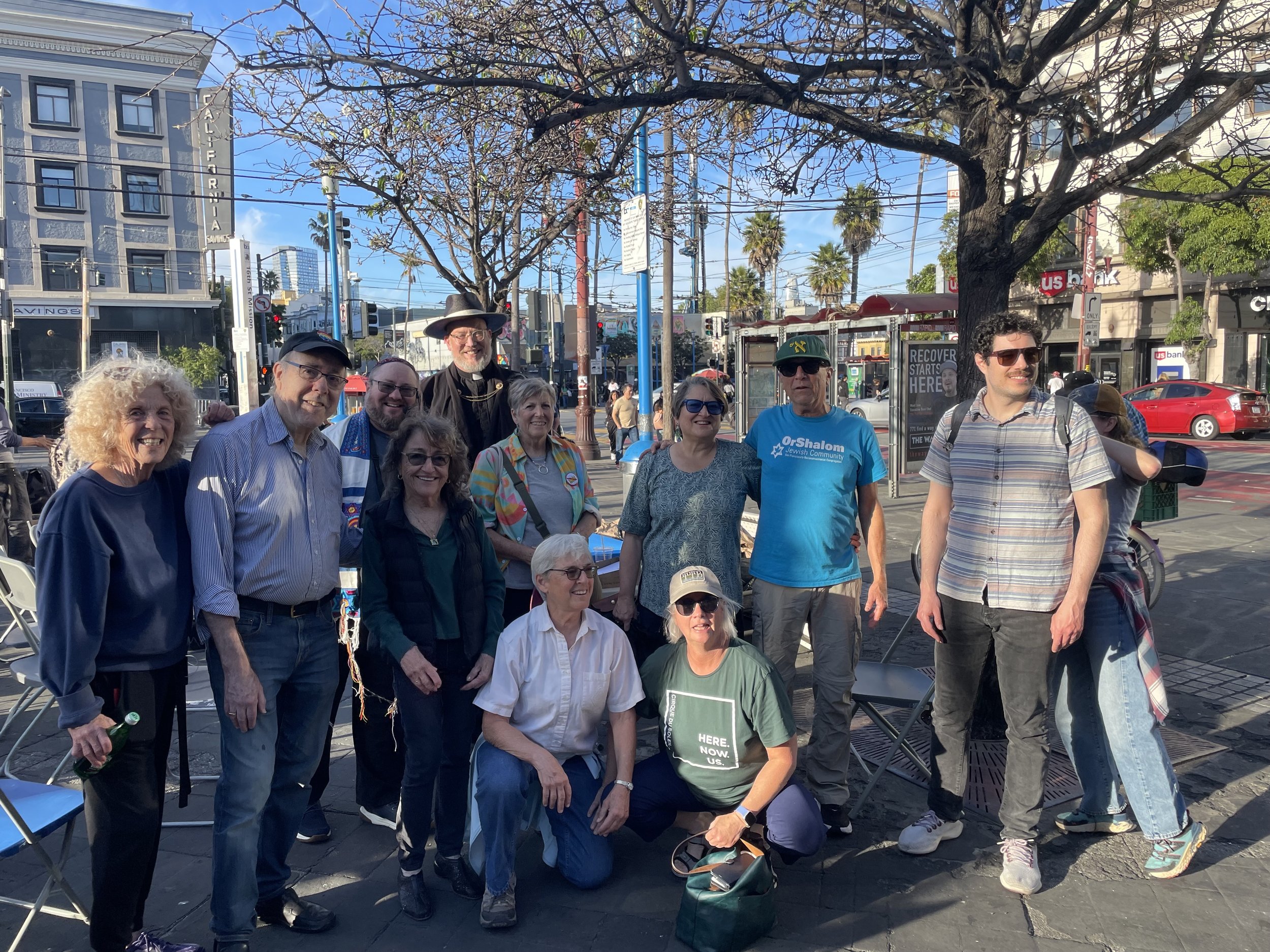
It’s Friday evening at 16th and Mission. Traffic hums, BART doors slide open and shut, and the city is in constant motion. People drift in and out of the plaza. Some are heading home. Some have nowhere in particular to go. And in the midst of it, Shabbat begins.
On the fourth Friday of each month, Open Shabbat gathers here. This week before Passover, the gathering is hosted by enthusiastic volunteers from the Or Shalom Jewish Community. They arrive early with food, bringing a shared meal that is as central to the evening as the service itself. And on this day, the gathering is large. Many come seeking connection, something to eat, a place to sit among others. Few, aside from the volunteers, identify as Jewish. Some who speak limited English don’t even realize it’s a Jewish service.
And yet, there it is. Rabbi Marty Rawlings-Fein stands at the front, wearing a kippah and tallit, leading prayers that include Hebrew words unfamiliar to many in the gathering. A printed bulletin makes the liturgy visible, even if not fully understood. But what strikes me most is how little that seems to matter. The invitation extends beyond language, beyond tradition, and into something more universal: a shared moment of welcome, of rest, of being together.
This evening has required some improvisations. Rabbi Jeremy Sher, who usually leads Open Shabbat, is away. Ritual items, including the usual tablecloths and candles, are gone with him. But Rabbi Marty adapts, using what he has.
Part of the Shabbat liturgy includes Lecha Dodi, “Come My Beloved,” a poetic welcome to the Sabbath. In many congregations, worshippers turn toward the doors of the synagogue during this prayer, symbolically turning away from the past week and toward sacred time. In the final stanza, some bow their heads as a gesture of greeting, of reverence, of arrival.
But at 16th and Mission, there are no synagogue doors.
The temple for Open Shabbat is the city itself, bounded by open sky, the movement of people, and the shared public space.
So Rabbi Marty improvises.
As the moment comes, he turns and bows, but toward the entrance of the 16th Street BART station. Then toward the doors of a city bus idling just behind him.
It’s unexpected, and yet it feels exactly right.
In that moment, the boundary between sacred and ordinary dissolves. The doors of transit, these places of departure and arrival, become thresholds of Shabbat. The city itself becomes the sanctuary.
Open Shabbat does not rely on walls to create meaning. It gathers people as they are: housed and unhoused, religious and not, fluent and searching. Some come for the meal, some for the prayers, some simply for the chance to sit among others without being turned away. The particulars of tradition remain present, but they are held with a kind of openness that allows everyone to belong, even without full understanding.
What I witness this evening is a living interpretation of ancient ritual. A tradition flexible enough to meet people where they are, and strong enough to carry its meaning into new spaces.
At 16th and Mission, Shabbat arrives not through doors that close off the world, but through doors that open into it.
And in that opening, there is welcome.
